How .NET Developers Modernize Legacy Applications Without a Big-Bang Rewrite
Most enterprise .NET estates were not built yesterday. Somewhere behind today's roadmap sits a Framework-era monolith holding years of business logic and quiet dependencies nobody wants to touch. The instinct is to “rip and replace” it, but a ground-up rewrite is one of the riskiest moves a technology leader can make. Teams that succeed at modernization take a different route: they migrate the application in small, verifiable slices while the business keeps running. This is exactly the kind of work experienced .NET developers are trained for, and it is why more companies now hire .NET developers specifically for incremental modernization rather than full rebuilds.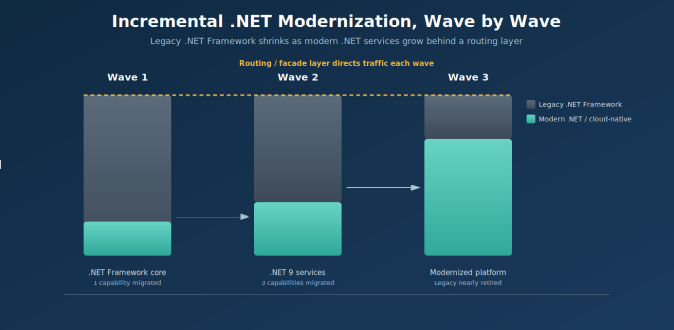
Why a Big-Bang Rewrite Rarely Works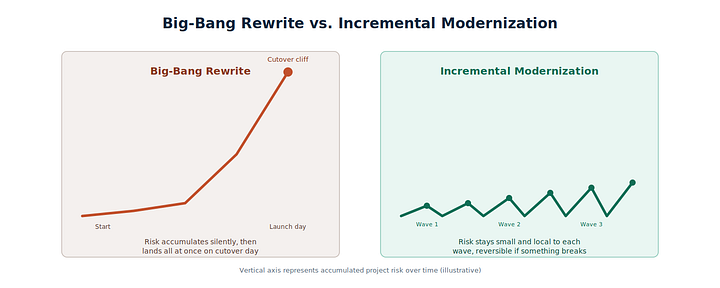
A Big Bang rewrite puts all of the risks of modernizing software into one big event. This means that instead of validating the changes and risks at each step of development, they are saved up until one day, and either all goes well or everything goes horribly wrong. In 2018 in the UK, one banking company shut out millions of its customers for days due to a single-event cutover failing, resulting in tens of millions of dollars in fees and expenses.
- Knowledge is lost forever: Reading and comprehending old code takes more effort than coding something from scratch, and years of experience with bug fixing in production is completely lost in a rewrite.
- There is no spec: Nobody has written down what exactly your old software does, so “feature parity” is not even achievable.
- Roadmap freezes: Development of new features stops as you try to catch up with your business requirements.
The Incremental Alternative: Modernize in Waves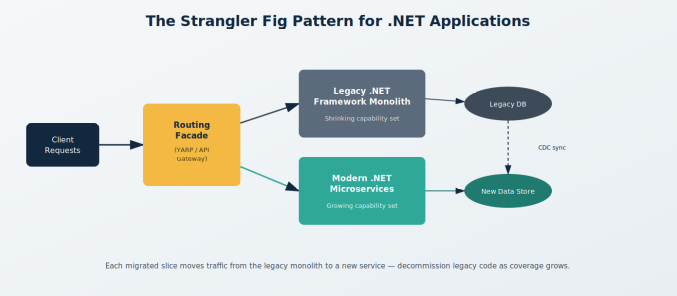
In contrast to a single major cutover, expert .NET developers perform the upgrade of a legacy system piece by piece. A routing layer precedes the application, capabilities are gradually added to the new platform one by one, and each piece is tested on production traffic while the legacy system is being phased out piece by piece. The two systems peacefully coexist, so any failure is just a small rollback, not an incident.
Four Proven Patterns .NET Developers Use to Modernize Legacy Systems
1. Strangler Fig Pattern
Strangler Fig is the pattern that should always be considered for migrating a monolithic application built using .NET Framework to microservices in modern .NET. In this case, a facade, which may be implemented through a reverse proxy (e.g. YARP) or API gateway, redirects requests from older and newer versions of the system, allowing the entire footprint of the legacy system to be shut down when all capabilities have been migrated to modern .NET.
2. Branch by Abstraction
When the component cannot be intercepted at the network edge (ORM, scheduler, data access layer), .NET programmers create an abstraction within the codebase. The old version of the component and the new one are sitting behind the same interface, controlled by the configuration settings.
3. Parallel Run
When dealing with areas that require correctness, such as payments, pricing, or eligibility logic, .NET applications compare the results generated by the legacy implementation and the new one when running them in parallel against live traffic, using only the result of the proven system. This step turns “we believe that they are equivalent” into a measurable mismatch rate before committing to a cutover.
4. Event Interception
In case the legacy application serves as a system of record, .NET developers intercept events sent to the application and send copies to the new pieces of software. In turn, the new system creates its state based on the interception and demonstrates the ability to catch up before switching itself to be the system of record.
Planning a Modernization Wave: A Practical Sequence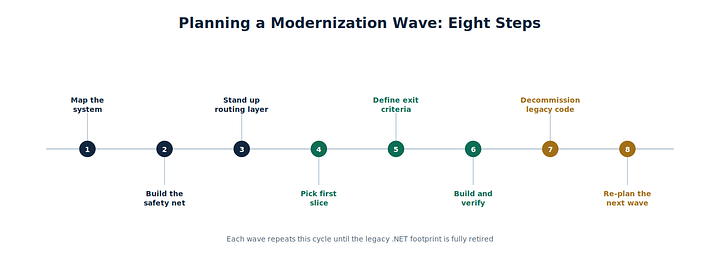
A “wave” is one complete migrate-validate-decommission cycle for a single slice of the application. Experienced .NET developers typically follow a repeatable sequence:
- Map the system and find the seams: find boundaries where a capability separates with minimal coupling.
- Build a safety net first: write tests that pin down current behavior before anything changes.
- Stand up the routing layer: let the facade carry all legacy traffic before it becomes load-bearing.
- Choose the first slice deliberately: pick something low-risk and finishable within weeks.
- Define exit criteria up front: agree on error budgets and rollback triggers before work starts.
- Build, verify, and shift traffic gradually: validate against production data at each ramp step.
- Decommission as part of the wave: remove legacy code paths once the new slice is trusted.
- Re-plan between waves: feed real results into the next wave's scope and budget.
Why Companies Hire .NET Developers for Modernization Programs
Incremental modernization requires a unique blend of skill sets, including proficiency in working with old .NET Framework codebases and knowledge of modern .NET architecture and cloud, as well as the ability to build temporary scaffolding that would later be dismantled. For this reason, businesses opt for hiring .NET developers who have modernization expertise rather than delegating the task to the rewrite team. Experienced .NET developers should be able to:
- Analyze and safely restructure undocumented legacy code without affecting the current functionality.
- Build a routing façade and data sync pipeline for legacy and new system coexistence.
- Monitor production systems to validate new .NET services with minimum disturbance.
- Leverage artificial intelligence programming bots for generating characterization tests, dependency mapping, and performing migration-related repetitive tasks under supervision.
No matter if you are going through modernization of your internal ERP, client-facing portal, or transactional core platform, having .NET developers with wave-based migration experience might become a determining factor in whether your project succeeds or ends up becoming an expensive hybrid.
Common Pitfalls Between Waves
- The permanent hybrid: Migration slows after early wins and both systems quietly run forever, doubling infrastructure costs.
- An overloaded facade: The routing layer becomes a single point of failure because it absorbs business logic instead of staying simple.
- Data drift: Dual writes and sync jobs silently diverge without continuous reconciliation.
- Scope creep inside a wave: “While we're in here” additions turn a three-week slice into a six-month detour.
When a Full Rewrite Still Makes Sense
Incremental modernization is a robust default choice; however, a complete rewrite is possible when the size of the system is small enough to be rewritten into one-quarter, when the legacy system is sealed code by a software vendor that cannot be intercepted, when the business process changes are being made, or when an external factor such as shutdown of the data center compels platform abandonment. Even in these cases, a rehearsal-based transition with fallback is preferred over an irreversible weekend transition.
| Also read: Node.js vs .NET: Which Backend Framework Is Right for Your Business?
Conclusion
Legacy .NET systems don't have to be an anchor on innovation, and they don't have to be replaced overnight to be modernized. By combining proven patterns strangler fig, branch by abstraction, parallel run, and event interception with disciplined wave planning, businesses can retire technical debt gradually while shipping new features the entire time. If your organization is weighing this path, the smartest first step is to hire .NET developers who specialize in incremental, low-risk modernization, so your legacy platform evolves safely instead of becoming the subject of the next big-bang cautionary tale.
